
Ethereum Betting Bankroll Management: Sizing Stakes in a Volatile Asset
 Available in US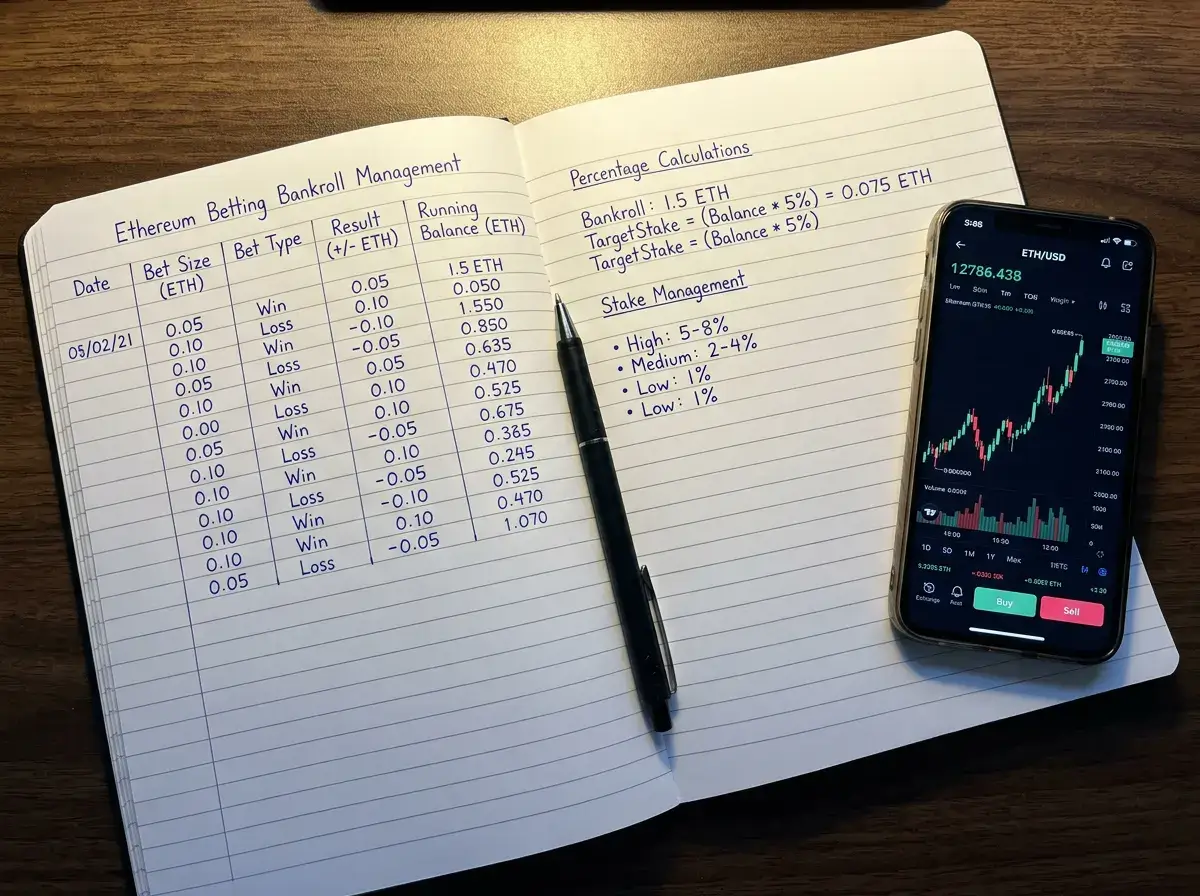
Traditional Bankroll Rules Break Down When Your Currency Moves
Every bankroll management system I learned during my first years of sports betting assumed one thing: the currency you bet with holds a stable value. Set your bankroll at $1,000 AUD, bet 2% per wager – $20 – and your risk is defined. But when your bankroll is 0.5 ETH, that 2% unit is 0.01 ETH. Today it might be worth $25 AUD. Next week it could be $20 or $30. The unit stays constant in ETH. The risk it represents in real-world purchasing power does not.
This is the fundamental challenge of managing a betting bankroll denominated in a volatile asset. Stablecoins account for over 70% of all crypto betting transactions in 2026 precisely because most bettors have decided the volatility problem is not worth solving – they sidestep it entirely. But for bettors who hold native ETH, whether by choice or because their platform operates in ETH, bankroll management needs to account for two sources of variance: betting outcomes and price movements.
Defining Units When Your Bankroll Fluctuates in Fiat Terms
BVNK’s research into how emerging-market users interact with crypto platforms made an observation that applies directly to bankroll management: users treat digital platforms as de-facto financial infrastructure, blurring the line between payment tool and value store. When your sportsbook balance is your ETH holding, and your ETH holding is part of your broader portfolio, the bankroll question becomes: how much of my total crypto position am I willing to risk on betting?
I use a dual-denomination approach. My bankroll is defined in AUD – say, $2,000 – and converted to ETH at the time of deposit. My unit size is calculated as a percentage of the AUD-denominated bankroll, not the ETH amount. If my bankroll is $2,000 AUD and I bet 2% units, my unit is $40 AUD worth of ETH, regardless of whether that is 0.016 ETH or 0.020 ETH on any given day.
This approach means recalculating unit sizes periodically – weekly or before each betting session – to account for ETH price changes. If ETH rises 10%, my 0.5 ETH bankroll is now worth $2,200 AUD, and my 2% unit increases to $44. If ETH drops 10%, the bankroll is $1,800, and the unit drops to $36. The percentage stays constant; the ETH amount per bet adjusts.
The alternative – fixing units in ETH (always bet 0.01 ETH regardless of price) – creates a hidden asymmetry. When ETH is expensive, your unit represents more AUD risk. When ETH is cheap, it represents less. Over time, you end up overexposed during bull runs and underexposed during dips, which is exactly backwards from optimal risk management.
Adjusting Stake Sizes for ETH Volatility
Standard bankroll advice says to risk 1% to 3% of your bankroll per bet. For fiat bettors, that range accounts for the variance inherent in betting outcomes. For ETH bettors, the range needs to be narrower because you are absorbing two variance sources simultaneously.
My rule of thumb: if your bankroll is in native ETH, reduce your standard unit percentage by roughly one-third. If you would normally bet 3% units with a stable currency, bet 2% units with ETH. If you would bet 2%, bet 1.3%. The reduction compensates for the price volatility that sits on top of your betting variance. It will not feel aggressive enough during a winning streak, but it provides survivability during the inevitable stretches where bad bets and a declining ETH price compound each other.
Ethereum holds about 9% of crypto gambling volume, and the bettors who use it tend to be more crypto-native and risk-tolerant than the average. That self-selection can create overconfidence in bankroll sizing. I have seen sharp bettors with genuine edge go broke not because their picks were wrong but because they sized their bets for a stable-value bankroll and ETH dropped 25% during a rough week. The edge was real. The bankroll management was not calibrated for the currency.
If your edge is strong and consistent – verifiable over hundreds of bets with a positive ROI at closing odds – you can apply the Kelly criterion with a volatility adjustment. Standard Kelly says to bet (edge / odds) as a fraction of your bankroll. For ETH, I multiply the Kelly fraction by 0.5 to 0.7, depending on how volatile ETH has been recently. This fractional Kelly approach sacrifices growth rate for survivability, which is the correct trade-off when your bankroll can shrink from price movements independently of your bet results.
When to Rebalance Between ETH and Stablecoins
Rebalancing is the practice of moving a portion of your bankroll between native ETH and stablecoins based on market conditions and your current exposure.
I rebalance at two triggers. First, when my unrealised ETH profit exceeds 20% of my bankroll – meaning ETH has appreciated significantly since my last rebalance – I convert a portion of the gains to USDT. This locks in profit in fiat-equivalent terms and reduces my downside if ETH reverses. Second, when my betting balance exceeds what I plan to wager in the next two weeks, the excess moves to stablecoins. There is no reason to hold ETH price risk on funds you are not actively using for bets.
The swap itself costs cents on Layer 2 DEXs. On Arbitrum, converting 0.5 ETH to USDT through a decentralised exchange takes 15 seconds and costs under $0.01 in gas. Stablecoins now account for over 70% of crypto betting transactions for good reason – they are the natural holding currency between bets, with ETH used for the active betting cycle.
A hybrid bankroll – 50% stablecoins for stability, 50% ETH for upside exposure – is a common configuration among bettors I know who want to maintain some ETH price exposure without letting volatility dictate their bankroll size. The split can be adjusted based on conviction: more ETH when you are bullish, more stablecoins when you are cautious. The key is that the decision is deliberate, not an accident of whichever currency happened to be in your wallet. For the detailed volatility scenarios that illustrate why this rebalancing matters, the volatility risk guide walks through three concrete examples of how ETH price swings change betting outcomes in AUD terms.
Should I track my betting bankroll in ETH or AUD?
Track in both, but make decisions based on the AUD value. Your unit sizes, risk management thresholds, and rebalancing triggers should reference the fiat-equivalent value of your bankroll, because that reflects your actual purchasing power and real-world risk exposure. Use the ETH denomination for executing trades on the sportsbook, but evaluate performance and size bets based on the AUD figure.
How does the Kelly criterion work with volatile crypto?
Apply a fractional Kelly approach – multiply the standard Kelly fraction by 0.5 to 0.7 to account for the additional variance from ETH price movements. Standard Kelly is already aggressive for fiat bankrolls; full Kelly with a volatile currency creates unacceptable risk of ruin. The fractional adjustment sacrifices some theoretical growth rate for dramatically improved survivability.
What percentage of my ETH should I allocate to a betting bankroll?
This depends on your overall financial situation and risk tolerance. A common guideline among serious crypto bettors is to allocate no more than 10 to 20% of total ETH holdings to a betting bankroll. The remainder stays in cold storage or staking. Within the betting bankroll, individual bet units should be 1 to 2% of the bankroll’s AUD value, adjusted for ETH volatility.