
Ethereum Betting dApps: How Fully Decentralised Wagering Works
 Available in US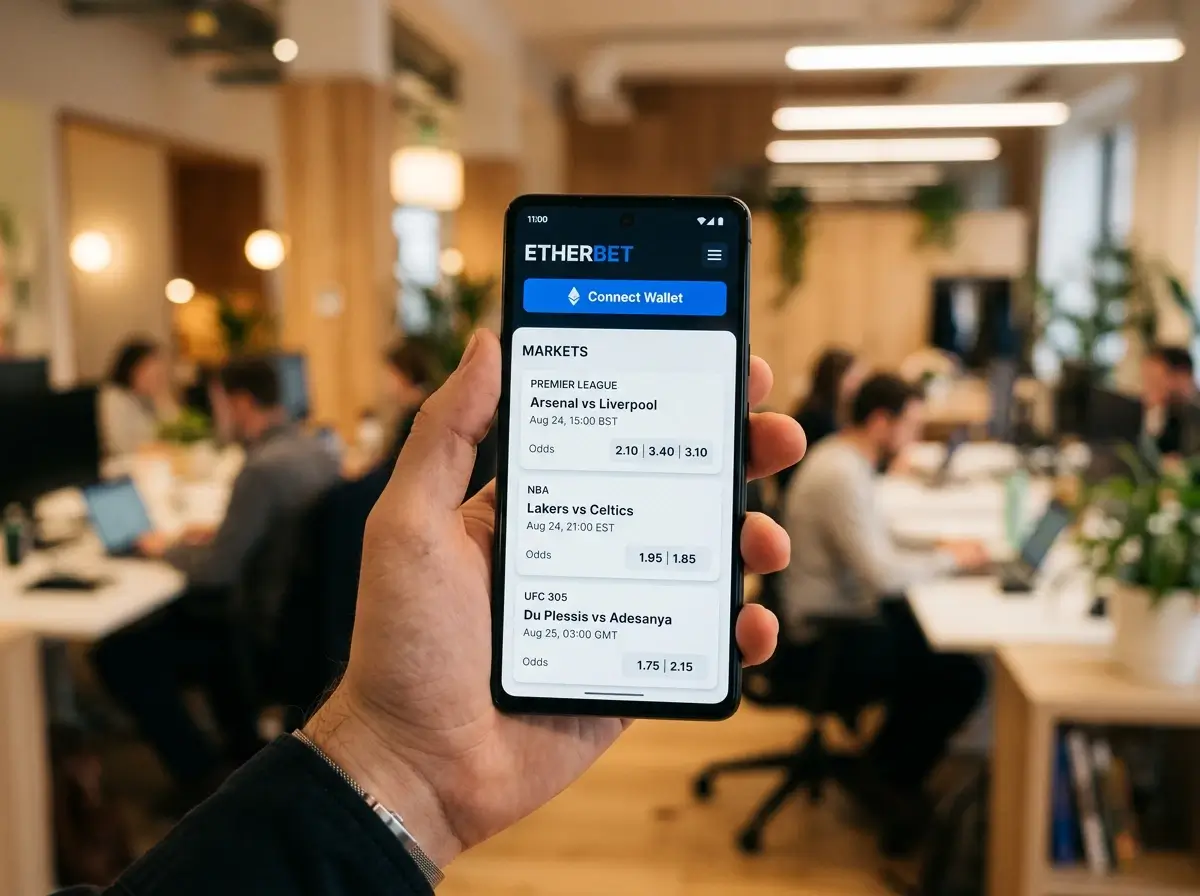
No Operator, No Account, No Custody – Just a Contract
The first time I placed a bet on a decentralised application, I did not create an account. I did not enter an email address, choose a password, or verify my identity. I connected my MetaMask wallet, selected a market, set my wager amount, and confirmed the transaction. The smart contract held my ETH in escrow until the outcome resolved, then paid me automatically. No operator decided whether to approve my withdrawal. No compliance team reviewed my transaction. The code did exactly what the code said it would do.
That experience – removing the human intermediary from every stage of the betting process – is the core promise of betting dApps. They run entirely on Ethereum smart contracts, with assets on Ethereum rollups now exceeding $37 billion. The infrastructure is no longer theoretical. Real ETH flows through real contracts that resolve real wagers without any centralised party controlling the process.
How Betting dApps Execute Wagers On-Chain
A betting dApp is a set of smart contracts deployed on Ethereum (or an Ethereum Layer 2) that handle the full lifecycle of a wager: accepting bets, holding funds in escrow, determining outcomes, and distributing payouts.
The bet placement works through a transaction. You interact with the dApp’s interface – a website that reads from and writes to the smart contract. When you place a bet, your wallet sends ETH to the contract with parameters specifying the market and your predicted outcome. The contract stores your bet on-chain and locks the funds.
Outcome resolution is the critical step and the one that distinguishes different dApp architectures. Some use oracle networks like Chainlink to feed external data (sports results, price feeds) into the contract. Others rely on decentralised resolution mechanisms where token holders vote on outcomes. A third model uses fully on-chain randomness for casino-style games, generating provably fair results without any external input.
Payout is automatic. Once the contract receives the outcome data and validates it, the winning bets are paid from the escrow pool in the same transaction. There is no withdrawal request, no processing queue, no manual approval. Ethereum processed 200.4 million transactions in Q1 2026 alone, and the smart contract payout is simply one more transaction in that flow – no different to the network than any other ETH transfer.
The entire process is auditable. Anyone can read the contract code, verify the escrow balance, check the oracle input, and trace the payout transaction. Every step is recorded on the blockchain permanently. This is the transparency that centralised sportsbooks cannot replicate, because their internal databases are private by design.
dApps vs Centralised ETH Sportsbooks: A Structural Comparison
The two models serve different needs, and conflating them leads to poor choices.
Centralised sportsbooks hold your funds in their own wallets. When you deposit ETH, you transfer custody to the platform. They owe you the balance as a liability on their books, similar to how a bank holds your deposit. The advantage is speed and feature richness – live betting, complex parlays, loyalty programmes, customer support. The disadvantage is counterparty risk. If the platform is hacked, insolvent, or fraudulent, your funds are at risk because you do not hold them.
Betting dApps never take custody of your funds. Your ETH moves from your wallet to a smart contract, and the smart contract holds it until resolution. You interact directly with the contract, not with a company. The advantage is eliminating counterparty risk – no operator can run off with the escrow. The disadvantage is limited functionality. Smart contracts cannot currently support the complexity of live in-play betting, multi-leg parlays across different sports, or the kind of market depth that centralised platforms offer.
User experience is another gap. Centralised platforms look and feel like polished web applications. Most betting dApps have functional but bare-bones interfaces that assume technical familiarity with Web3 wallets, gas estimation, and transaction confirmation flows. The audience for dApps skews toward DeFi-native users who are comfortable with these mechanics, not the mainstream bettor who just wants to back a team and cash out.
Current Limitations of Decentralised Betting
For all their architectural elegance, betting dApps have real limitations that constrain their adoption in 2026.
Liquidity is the fundamental constraint. A centralised sportsbook provides liquidity through its own balance sheet – it takes the other side of every bet. A dApp needs liquidity providers who deposit ETH into pools that back the wagers. If the pool is shallow, the dApp can only accept small bets. Attracting liquidity providers requires offering returns that compete with DeFi lending and staking, where ETH staking alone generates about 2.84% annually. The economics are tight.
Market coverage is narrow compared to centralised platforms. Building a smart contract for a football match result is straightforward. Building contracts for first goalscorer, correct score, Asian handicaps, and 200 other market types – each with its own settlement logic and edge cases – is an enormous development effort. Most dApps focus on a handful of high-volume markets rather than trying to replicate the depth of a traditional sportsbook.
Oracle dependency introduces a trust assumption that “trustless” marketing glosses over. If a dApp uses Chainlink for sports results, the system trusts that Chainlink delivers accurate data. Chainlink has an excellent track record, but it is a centralised point of dependency within a decentralised system. Layer 2 networks process about 95% of Ethereum’s total transaction volume, and dApps built on L2 inherit the speed benefits, but the oracle question remains regardless of which layer the contract runs on.
Regulatory uncertainty affects dApps differently than centralised platforms. A centralised sportsbook can obtain a licence, implement KYC, and operate within a regulatory framework. A smart contract deployed on Ethereum has no legal entity behind it, no jurisdiction of incorporation, and no compliance officer. This creates a grey zone where the dApp itself may be unstoppable but the people who built it, fund it, or operate its frontend interface are potentially liable. For a technical deep dive into how the smart contracts behind these platforms verify fairness, the provably fair mechanics guide explains the cryptographic systems that make trustless verification possible.
Do I need a crypto wallet to use a betting dApp?
Yes. Betting dApps interact directly with your Ethereum wallet – there are no accounts, no usernames, and no passwords. You connect a wallet like MetaMask, and the dApp reads your balance and sends transactions through it. Your wallet is your identity and your payment method simultaneously. Without a Web3 wallet, you cannot interact with any dApp.
Are decentralised betting dApps legal in Australia?
The legal status is unclear. The Interactive Gambling Act targets operators providing gambling services to Australians, but a smart contract deployed on a public blockchain has no operator in the traditional sense. The people who deploy, maintain, or promote the dApp’s frontend interface may face legal risk, but the contract itself runs autonomously. This regulatory grey zone has not been tested in Australian courts.
Can a betting dApp be shut down by regulators?
The smart contract itself, once deployed on Ethereum, cannot be removed or altered by any authority. However, regulators can target the frontend website that users access to interact with the contract, block the domain, and pursue the individuals or companies behind the project. The contract continues to exist on-chain, but accessing it without the frontend requires technical knowledge that most users do not have.