
Ethereum Betting Odds Formats: Reading Lines on Crypto Sportsbooks
 Available in US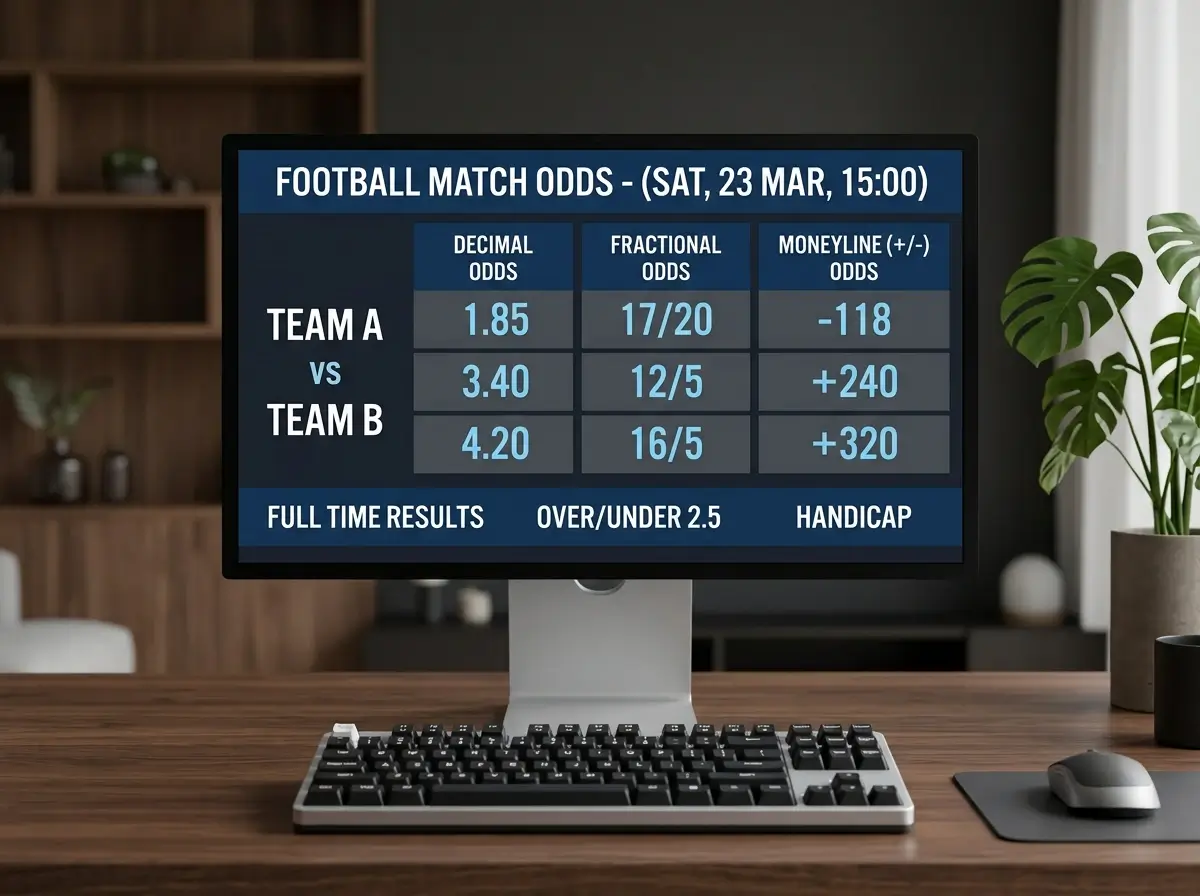
Crypto Sportsbooks Default to Decimal – Here Is Why
When I switched from an Australian-licensed sportsbook to my first crypto platform, the odds display felt immediately familiar. Decimal format everywhere – 1.95, 2.10, 3.40 – exactly what I was used to. Then I helped a mate from the States set up his account on the same platform, and he was completely lost. Where were the moneylines? What does 1.95 even mean?
Crypto sportsbooks default to decimal odds because their audience is global. Europe holds nearly 57% of the worldwide online gambling market share, and decimal is the standard across the continent. Australia, Canada, and most of Asia also use decimal. When you are building a platform for a borderless, crypto-native audience, you go with the format that works for the majority. Sports betting itself accounts for over 52% of the online gambling market, and the dominant format in that segment globally is decimal.
For Australian bettors, this is convenient – decimal is home ground. But many crypto platforms also accept users from the US, UK, and other regions, so you will occasionally encounter American (+150, -200) or fractional (3/1, 5/2) odds on the same platform. Understanding all three formats is not just academic – it lets you compare lines across platforms efficiently, which is where betting edge actually lives.
Decimal, Fractional, and American Odds Explained
Decimal odds tell you the total return per dollar wagered, including your stake. Odds of 2.50 mean a $10 bet returns $25 – your $10 stake plus $15 profit. Odds of 1.50 return $15 on a $10 bet – $10 back plus $5 profit. The number always includes the stake, which makes calculating payouts trivially simple: stake multiplied by odds equals total return.
Fractional odds, used primarily in the UK and Ireland, express profit relative to stake. Odds of 3/1 (“three to one”) mean $3 profit for every $1 staked. Odds of 1/2 (“one to two”) mean $1 profit for every $2 staked. The total return is the fraction plus one, multiplied by the stake. Fractional odds are intuitive for simple fractions (3/1, 5/1) but become unwieldy for precise lines (11/8, 13/5).
American odds centre on $100 as the reference point. Positive numbers (+150) tell you the profit on a $100 bet: +150 means $150 profit. Negative numbers (-200) tell you how much you must bet to profit $100: -200 requires a $200 bet for $100 profit. The format is deeply ingrained in US sports culture but confusing to everyone else, which is why crypto sportsbooks rarely default to it.
Each format conveys the same underlying information. Decimal 2.50 equals fractional 3/2 equals American +150. The sportsbook’s margin is identical regardless of how the odds are displayed. The format is a presentation choice, not a mathematical one.
Converting Between Formats Without a Calculator
I do these conversions in my head constantly when comparing lines across platforms. Here are the shortcuts that actually work under time pressure.
Decimal to fractional: subtract 1, then express as a fraction. Decimal 2.50 becomes 1.50, which is 3/2. Decimal 1.80 becomes 0.80, which is 4/5. For clean decimals, this is instant. For ugly numbers like 1.87, approximate: 0.87 is close to 7/8, good enough for a quick comparison.
Decimal to American: if the decimal is 2.00 or above, the formula is (decimal minus 1) times 100. Decimal 3.00 becomes +200. If the decimal is below 2.00, divide negative 100 by (decimal minus 1). Decimal 1.50 becomes -100 divided by 0.50, which is -200. The mental arithmetic gets easier with practice, and for live betting comparisons, approximation is more useful than precision.
American to decimal: for positive American odds, divide by 100 and add 1. +250 becomes 3.50. For negative odds, divide 100 by the absolute value and add 1. -250 becomes 1.40. This conversion is the one I use most, since some crypto platforms display American odds for US sports markets even when the rest of the site uses decimal.
The core principle: you do not need to memorise every conversion formula. You need to be able to compare two prices quickly. If one sportsbook shows +180 and another shows 2.90, you need to know that 2.90 is better (+180 converts to 2.80). That comparison is where value lives.
Implied Probability and Overround on ETH Sportsbooks
Behind every set of odds is an implied probability – the chance the sportsbook is pricing into the outcome. Decimal odds convert to implied probability by dividing 1 by the odds. Odds of 2.00 imply a 50% chance. Odds of 4.00 imply 25%. Odds of 1.25 imply 80%.
The overround is the sportsbook’s margin – the amount by which the implied probabilities of all outcomes in a market exceed 100%. In a two-outcome market, if both sides are priced at 1.91, the implied probability of each is 52.4%. The total is 104.8%, giving the sportsbook a 4.8% overround. That overround is the house edge, the price you pay for the privilege of betting.
Crypto sportsbooks tend to advertise lower margins than traditional platforms, pointing to reduced operating costs from crypto payment infrastructure. Whether the actual overround is lower varies. I have measured overrounds on major football markets across five crypto sportsbooks and five traditional Australian bookmakers, and the crypto platforms averaged 4.5% to 5.5% overround compared to 5% to 7% on the traditional side. The difference is real but modest, and it narrows on heavily traded markets where competition compresses margins everywhere.
For ETH bettors, the practical application is straightforward: before placing any bet, convert the odds to implied probability and compare it to your own assessment of the true probability. If you think a team has a 55% chance of winning and the odds imply 48%, you have found value. The format of the odds does not matter – the implied probability underneath is what determines whether the bet is worth making. For a deeper analysis of how margins compare between crypto and traditional platforms, the sportsbook evaluation framework includes margin comparisons across market types.
Why do most crypto sportsbooks use decimal odds by default?
Crypto sportsbooks serve a global audience, and decimal odds are the standard in Europe, Australia, Canada, and most of Asia. Since Europe alone accounts for nearly 57% of global online gambling revenue, decimal is the format that works for the majority of users. Most platforms also offer the option to switch to American or fractional display in your account settings.
How do I calculate implied probability from decimal odds?
Divide 1 by the decimal odds. Odds of 2.00 imply a 50% probability (1 divided by 2.00). Odds of 3.00 imply 33.3%. Odds of 1.50 imply 66.7%. If the implied probability is lower than your assessment of the true probability, the bet offers value. This calculation works the same regardless of the sportsbook or payment method.
Can I switch odds formats on an ETH betting site?
Most crypto sportsbooks include an odds format toggle in your account settings, allowing you to switch between decimal, fractional, and American display. Some platforms also let you set a default format that applies sitewide. If the option is not visible in settings, check the odds display area on the betting page – some sites place a format selector directly next to the odds.