
Ethereum vs Bitcoin for Betting: A Side-by-Side Comparison
 Available in AU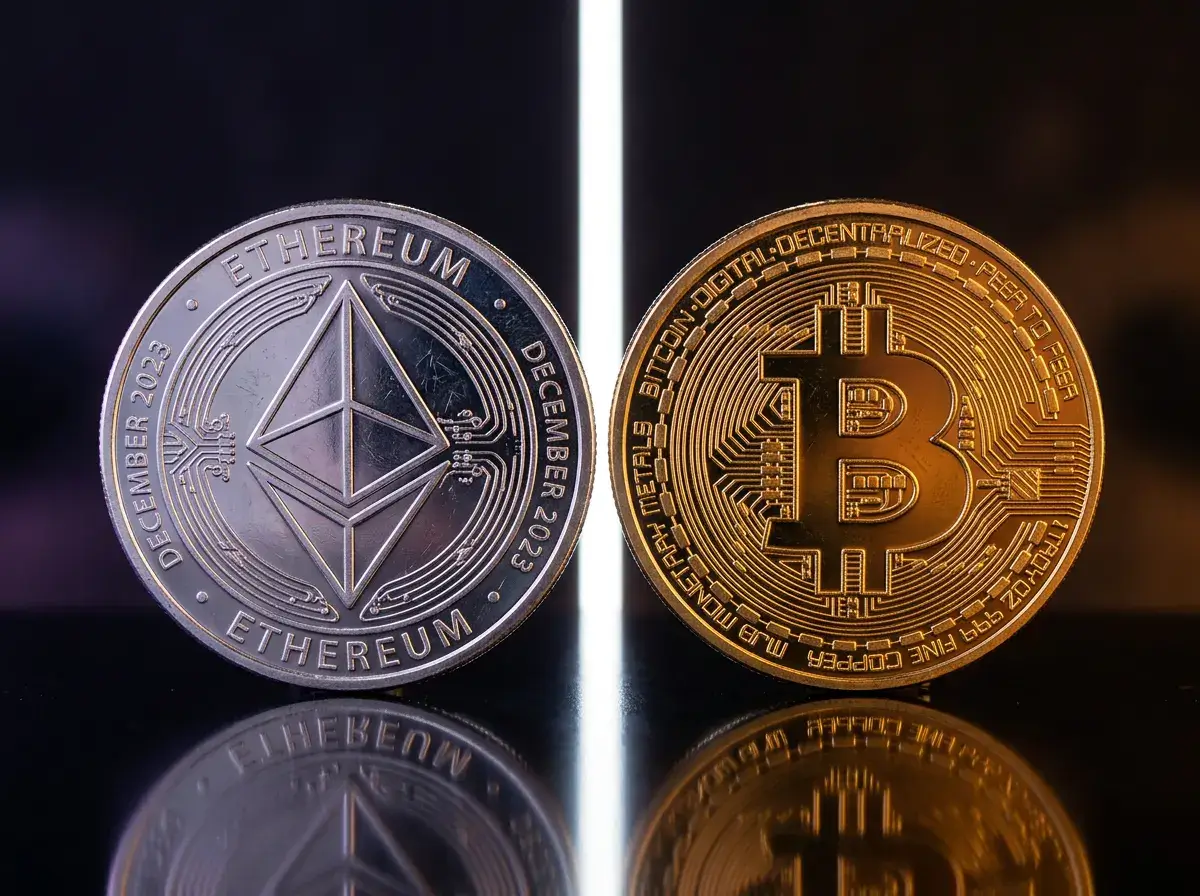
Two Blockchains, Two Betting Experiences
A few years back, a colleague and I placed the same bet on the same platform at the same time — he deposited with Bitcoin, I used Ethereum. My deposit confirmed and I had the bet placed before his transaction even appeared as pending. He ended up missing the pre-match odds entirely and had to take a worse live line. That single experience encapsulates the practical difference between these two blockchains for betting, and it has only widened since.
The ETH vs BTC debate in crypto circles tends to revolve around investment thesis, decentralisation philosophy, and monetary policy. None of that matters much when you are trying to get funds into a sportsbook before kickoff. For bettors, the comparison comes down to a handful of concrete factors: how fast your money moves, how much the transaction costs, what the blockchain can do beyond simple transfers, and how widely each currency is accepted.
Bitcoin still commands roughly 66% of all crypto gambling volume, with Ethereum sitting at about 9% and stablecoins growing fastest of all. Those numbers might suggest Bitcoin is the obvious choice. But market share reflects history and habit more than current capability. Bitcoin dominated because it was first, because early crypto sportsbooks built their infrastructure around it, and because bettors who already held BTC had no reason to convert. The question is not which crypto has the most users — it is which one gives you a better betting experience today.
I am not here to tell you that one is objectively better. I have used both extensively across dozens of platforms, and the right choice depends on your priorities. What I can do is lay out the data across every dimension that actually affects your betting experience and let you make an informed decision. No tribal allegiance, no “my chain is better than yours” — just the practical reality of depositing, wagering, and withdrawing on two very different blockchains.
Transaction Speed and Settlement Finality
Ethereum produces a new block approximately every 12 seconds. Bitcoin produces one roughly every 10 minutes. That difference alone tells most of the story, but the practical gap is wider than the raw numbers suggest.
When you send ETH to a sportsbook, the transaction is typically visible in the mempool within seconds and included in a block within 12 to 24 seconds. Most platforms require between 1 and 12 confirmations before crediting your account. At 12 seconds per block, 12 confirmations take about two and a half minutes. A single confirmation — which some platforms accept for deposits — takes under 15 seconds.
Bitcoin’s 10-minute block time means a single confirmation takes, on average, 10 minutes. But Bitcoin blocks are not produced at precise intervals — the actual time between blocks follows a Poisson distribution, meaning any individual block could take 1 minute or 40 minutes. Most sportsbooks require 2 to 3 Bitcoin confirmations, which translates to a typical wait of 20 to 30 minutes but can stretch to an hour or more during unlucky block intervals.
For pre-match betting with plenty of time before an event, this difference is an inconvenience rather than a dealbreaker. For live betting — where odds shift by the second — it changes the entire dynamic. You cannot fund a live betting account with an unconfirmed Bitcoin transaction. Either you pre-fund your account well in advance, or you watch the odds you wanted disappear while your BTC transaction sits in the mempool.
Ethereum’s speed advantage extends further with Layer 2 networks. Transactions on Arbitrum or Optimism reach soft finality in under a second and hard finality on mainnet within minutes. Ethereum set a record of 2.89 million transactions processed in a single day in February 2026, demonstrating that the network can handle high throughput without the confirmation delays that plague Bitcoin during busy periods.
Settlement finality is the other dimension. Ethereum’s proof-of-stake consensus provides economic finality after two epochs (roughly 13 minutes), after which reversing a transaction would require destroying billions of dollars worth of staked ETH. Bitcoin’s proof-of-work provides probabilistic finality — the more confirmations, the more computationally expensive a reversal becomes, but there is no absolute threshold. For betting purposes, both chains offer sufficient finality for typical deposit amounts well before the sportsbook credits your account.
There is one more speed consideration that often gets overlooked: withdrawal processing. Sportsbooks batch their outgoing transactions differently for each chain. Because ETH transactions are cheaper and faster, some operators run their ETH withdrawal queue more frequently than their BTC queue. I have seen platforms process ETH withdrawals every 15 minutes but BTC withdrawals only twice daily. The blockchain speed advantage is real, but the operator’s internal processing cadence can amplify or nullify it entirely.
Fee Structures: Gas vs Mining Fees
Two years ago, this section would have been an easy win for Bitcoin. Ethereum gas fees during the 2021-2022 bull market regularly exceeded $20 for a simple transfer, while Bitcoin fees hovered around $1-3. That dynamic has reversed so completely that it is worth dwelling on the numbers.
A basic ETH transfer in March 2026 costs approximately $0.01 on mainnet. Average gas across all transaction types sits between $0.16 and $0.22. On Layer 2 networks, fees drop below $0.01 per transaction. The average gas price has fallen to 0.052 Gwei from 1.67 Gwei a year prior — a decline of over 96%.
Bitcoin transaction fees are structurally different. They are based on transaction size in bytes (not computational complexity) and on competition for block space. A standard Bitcoin transaction is roughly 250 bytes. During normal conditions in 2026, fees for a next-block confirmation sit around $0.50 to $2.00. During congestion events — like the Ordinals inscription craze that periodically spikes Bitcoin mempool activity — fees can jump to $10 or more.
The key structural difference: Ethereum has a scaling roadmap that actively reduces fees over time. Layer 2 networks, which now handle about 95% of all Ethereum transaction volume, have cut effective costs by 97 to 99% compared to mainnet. Bitcoin’s Lightning Network offers similar cost reductions for BTC, but its adoption among sportsbooks is negligible. Almost no betting platform accepts Lightning deposits, meaning you are stuck with on-chain BTC fees.
For a bettor making regular deposits, the fee difference compounds. Twelve monthly deposits at $1.50 each on Bitcoin cost $18 per year. The same twelve deposits via Ethereum L2 cost less than $0.12. That $18 difference will not make or break anyone’s bankroll, but it illustrates the direction of travel: Ethereum’s fee trajectory is sharply downward, while Bitcoin’s fluctuates with no clear scaling solution for on-chain transactions.
There is a counterargument worth acknowledging. Bitcoin fees include no “surprise” complexity costs. With Ethereum, a simple transfer is cheap, but interacting with a smart contract (token approvals, contract-based deposits) uses more gas and costs more. A bettor who does not understand the difference might see an unexpectedly high gas estimate and panic. Bitcoin’s fee model is simpler: the transaction size determines the cost, regardless of what the transaction does. Simplicity has value, even when the absolute cost is higher.
Smart Contracts: Ethereum’s Structural Edge
This is where the comparison stops being about marginal improvements and becomes about a fundamentally different capability. Bitcoin can transfer value. Ethereum can transfer value and execute arbitrary logic. That distinction matters enormously for betting.
Smart contracts on Ethereum enable provably fair betting systems — platforms where the outcome of a wager is determined by verifiable on-chain randomness rather than a server-side algorithm you have to trust. About 77% of crypto-native platforms now offer some form of provably fair gaming, and the overwhelming majority of those run on Ethereum or Ethereum-compatible chains. Bitcoin’s scripting language is deliberately limited and does not support the kind of complex logic required for on-chain bet resolution.
The practical applications go beyond fairness verification. Smart contract escrow means your wager can be held in a contract that neither you nor the operator can unilaterally withdraw from — the funds are released only when the outcome condition is met. Automated payouts eliminate the manual withdrawal processing that creates delays on centralised platforms. Oracle integration through services like Chainlink VRF allows sports results to be fed on-chain in a tamper-resistant way, triggering automatic settlement.
Bitcoin does have smart contract capabilities through projects like Stacks and RSK, but these are sidechains with their own trust assumptions, not native Bitcoin functionality. The developer ecosystem around Ethereum smart contracts is orders of magnitude larger, which means more innovation, more auditing tools, more security research, and ultimately more reliable betting infrastructure.
For casual bettors who deposit on a centralised sportsbook and place standard pre-match wagers, smart contracts may seem irrelevant. But they underpin the difference between a platform that can prove its fairness and one that simply claims it. Tim Miller, Executive Director of the UK Gambling Commission, has spoken about supporting innovation as a central consumer protection tool — and smart contract transparency is exactly the kind of innovation he is describing. As the industry matures, the platforms built on verifiable on-chain logic will increasingly distinguish themselves from those that operate as black boxes.
There is also a forward-looking dimension. Ethereum’s smart contract ecosystem is where new betting models are being built — prediction markets, peer-to-peer wagering pools, automated market makers for sports outcomes. These innovations are structurally impossible on Bitcoin’s base layer. If the future of crypto betting involves more than just depositing fiat-equivalent value and placing traditional bets, that future is being built on Ethereum.
Adoption Numbers: Which Crypto Dominates Betting?
Numbers first, narrative second. Bitcoin holds approximately 66% of crypto gambling volume. Ethereum accounts for about 9%. Litecoin takes roughly 6%. The rest is split among dozens of altcoins and — increasingly — stablecoins, which are the fastest-growing payment method in the sector.
Bitcoin’s dominance has actually been declining. Over the course of 2025, BTC’s share of crypto gambling dropped from 88% to 77%. That is a significant erosion of market share in a single year. The primary beneficiary was not Ethereum but Tether (USDT), which surged as bettors discovered the practical advantages of wagering with a stable-value asset rather than a volatile one.
The crypto casino industry is generating $81 billion in annual revenue and attracting institutional capital at a pace that would have seemed absurd five years ago. Within that market, Ethereum’s 9% translates to roughly $7.3 billion in annual volume — not dominant, but not negligible. And the figure understates Ethereum’s actual influence because many stablecoin transactions (USDT, USDC) run on the Ethereum network or its Layer 2 extensions. When you include ERC-20 stablecoin volume, Ethereum’s infrastructure underpins a substantially larger share of the market than the 9% figure suggests.
Sports betting specifically has seen explosive growth within crypto gambling, surging from 3.15% to 14.83% of total interest over 2025. That growth is pulling a different demographic into crypto betting — one more focused on odds quality and market depth than on casino games. These bettors tend to be more analytically minded and more likely to evaluate the technical merits of their payment method, which favours Ethereum’s speed and smart contract capabilities over Bitcoin’s first-mover advantage.
The demographic data reinforces this. About 40% of crypto gambling participants are aged 25 to 34, with another 35% in the 35 to 44 bracket. This is a tech-literate audience that is comfortable with wallet management and blockchain concepts. For this group, Ethereum’s additional complexity is not a barrier — it is a feature set they already understand from interacting with DeFi and NFT ecosystems.
Acceptance rates tell a similar story. Nearly every crypto sportsbook accepts Bitcoin — it is the default. Ethereum acceptance is slightly less universal but covers the vast majority of established platforms. The practical difference for a bettor choosing between the two is minimal: you will rarely find a platform that accepts ETH but not BTC, or vice versa. The choice is about the experience once you are on the platform, not about access to it.
Volatility Compared: ETH vs BTC Price Swings
Both ETH and BTC are volatile assets, and using either as a betting currency means your bankroll fluctuates in fiat terms even when you are not placing wagers. But the volatility profiles are not identical, and the difference matters.
Historically, ETH has exhibited higher annualised volatility than BTC. In practical terms, this means your Ethereum-denominated bankroll can gain or lose more fiat value over a given period than a Bitcoin-denominated one. A 10% overnight move in ETH is not unusual during periods of market stress. BTC experiences similar swings but somewhat less frequently and with lower magnitude on average.
For bettors, this creates an asymmetric risk. You can win a bet and still lose money in fiat terms if the underlying asset drops during the settlement period. Conversely, you can lose a bet but partially offset the loss if the asset appreciates. This is not a feature — it is an uncontrolled variable that adds noise to your betting results.
Stablecoins are projected to account for over 70% of all crypto betting transactions in 2026, and this statistic is directly attributable to volatility avoidance. Bettors who want the blockchain benefits of crypto (speed, low fees, pseudonymity) without the price risk increasingly deposit in USDT or USDC rather than native ETH or BTC. The stablecoin approach to Ethereum betting removes the volatility variable entirely while keeping you within the Ethereum ecosystem.
If you choose to hold your bankroll in native ETH or BTC, the volatility comparison slightly favours Bitcoin for conservative bettors — its price action is generally less extreme. But the difference is marginal compared to the volatility of both assets relative to fiat. If price stability matters to you, stablecoins solve the problem entirely regardless of which blockchain you prefer.
One practical tip from experience: if you must hold your betting bankroll in a volatile asset, time your withdrawals carefully. I have seen bettors sit on a profitable ETH balance for weeks, only to withdraw during a price dip that wiped out their betting profits in AUD terms. The volatility is a two-way street, and it does not care about your bet outcomes. Keep an eye on the exchange rate when you are ready to cash out — waiting a day or two for a better exit can be more valuable than the edge you gained on the bets themselves.
When Bitcoin Still Makes More Sense
I have spent most of this article highlighting Ethereum’s technical advantages, so let me be direct about where Bitcoin is still the better choice. Intellectual honesty matters more than advocacy.
If you already hold BTC and do not hold ETH, converting to Ethereum for the purpose of making a sportsbook deposit adds an exchange step, an exchange fee, and a taxable disposal event (in Australia, the ATO treats crypto-to-crypto swaps as capital gains events). Unless you plan to make many deposits over time, the conversion overhead negates the per-transaction savings.
If the sportsbook you prefer has a mature Bitcoin infrastructure — fast crediting, low minimum thresholds, automated withdrawals — but has only recently added ETH support, the Bitcoin experience may be more reliable. Some platforms bolt on Ethereum acceptance as an afterthought, with higher confirmation requirements, manual processing, or limited network support. A well-implemented BTC integration beats a poorly-implemented ETH one every time.
Bitcoin also has an advantage in raw brand recognition and liquidity. It is the most liquid cryptocurrency, with the deepest order books on every exchange. Buying and selling BTC with AUD is marginally faster and cheaper than doing the same with ETH on most Australian exchanges. For a bettor who values simplicity and liquidity above speed and smart contract capability, Bitcoin remains a perfectly functional choice.
And there is the network reliability argument. Bitcoin’s simplicity is a feature, not a bug, when it comes to transaction predictability. There are no smart contract interactions to worry about, no token approval steps, no risk of sending to a contract address that behaves unexpectedly. You send BTC to an address, it arrives, end of story. For bettors who find Ethereum’s additional complexity intimidating rather than empowering, Bitcoin’s straightforward transfer model has genuine appeal.
The bottom line is this: neither blockchain is wrong for betting. Bitcoin is simpler, more liquid, and more widely held. Ethereum is faster, cheaper at scale, and structurally more capable. Your choice should depend on what you already hold, how often you transact, and whether smart contract features matter to your betting style. If you bet occasionally and already hold BTC, converting to ETH for marginal fee savings makes no sense. If you bet frequently, value speed, or want access to provably fair platforms, Ethereum’s advantages compound over time.
ETH vs BTC Betting Questions Answered
Which cryptocurrency is accepted by more sportsbooks?
Bitcoin has slightly wider acceptance, as it was the first cryptocurrency integrated by most platforms. However, the gap is narrow — the vast majority of crypto sportsbooks accept both BTC and ETH. You are unlikely to encounter a platform that accepts one but not the other among established operators.
Is Ethereum faster than Bitcoin for betting withdrawals?
Yes. Ethereum’s block time of roughly 12 seconds means transactions confirm far faster than Bitcoin’s average 10-minute blocks. A typical ETH withdrawal reaches your wallet within minutes, while a BTC withdrawal can take 20 to 60 minutes depending on the number of confirmations required and current network conditions.
Can I convert BTC to ETH directly on a sportsbook?
Some platforms offer internal conversion between supported cryptocurrencies, but the exchange rates are typically unfavourable compared to using a dedicated exchange. If you want to switch from BTC to ETH, you will generally get a better rate by withdrawing to an exchange, converting there, and re-depositing in ETH.
Does Ethereum’s smart contract support matter for casual bettors?
For day-to-day wagering on a centralised sportsbook, smart contracts operate in the background and may not visibly affect your experience. Where they matter is in provably fair verification — the ability to independently confirm that a bet outcome was determined fairly. If transparency and verifiability are important to you, Ethereum’s smart contract infrastructure provides tools that Bitcoin simply cannot match.
The full picture is in our Ethereum betting guide.
The cost difference is detailed in Ethereum gas fees.